Receive first-hand news on the latest bond issues, credit updates and special events when you join us on our Telegram channel at https://t.me/bondsupermart!
Additional Tier 1 (“AT1”) bonds now face scrutiny after Credit Suisse’s AT1 bonds were fully written-off. AT1 bond investors experienced its first major write-off from a Globally Systematically Important Bank since the creation of these ‘hybrid’ debt securities.
This was not the first time AT1 bonds were written off. Yes Bank, one of India’s largest private banks, wrote-down their AT1 bonds in 2020 due to a fall in capital adequacy and asset quality. Spanish Bank, Banco Popular, also saw a write-down of their AT1 bonds after the European Central Bank deemed the bank at a point of non-viability and placed the bank in resolution. With the recent write-down of Credit Suisse’s AT1 bonds, what lies in store for the future of these risky hybrid bank bonds?
Contagion to other banks?
We think that the crisis faced by Silicon Valley Bank (“SVB”) and CS are idiosyncratic and the fallout was due to the banking profiles of the two banks. For SVB, the fall of SVB was ultimately because of poor risk management and its unique banking model. SVB invested in UST in order to earn interest income from customer deposits. This is not unique to SVB and most major banks invest customer deposits into USTs. For SVB’s case, the failure to hedge its long-term USTs led the bank to book massive losses when they were required to sell their holdings to fund withdrawals. The loss in its books started the initial frenzy which eventually led to a bank run.
SVB also did not have a diversified banking model where it served mainly VC firms and tech start-ups within the technology and life sciences sectors. SVB saw a large influx of cash during the pandemic as loose monetary policy allowed for many tech start-ups to grow tremendously. These companies opted to park their cash in SVB. This large corporate client base led to huge amounts of deposits being uninsured.
For the case of CS, the bank booked losses for FY22 and was in a middle of a restructuring to de-risk its business model. On top of that, the banks also faced controversy after controversy leading up to its fallout. In October 2022, CS faced negative rumours that the bank was in the brink of insolvency on social media. In late June 2022, CS made the headlines again as the Switzerland Federal Criminal Court found Credit Suisse guilty of failing to prevent money-laundering relating to a Bulgarian drug ring. The latest negative news from its largest shareholder was the straw that broke the camel's back that ultimately led to huge client withdrawals that required the Swiss National Bank to step in and the eventual merger between CS and UBS.
There is minimal contagion risk from the merger between UBS and CS. CS will be transferred in full to UBS and only CS AT1 bondholders are affected for now. For CS Tier 2 bondholders, there is still some risk in further write-downs as Tier 2 bonds will be the next set of bail-in bonds to absorb losses. Senior management from UBS confirmed that depositors and senior bondholders will be transferred to UBS once the merger is completed but have not explicitly gave their confirmation that Tier 2 bonds will be safe from further write-downs. CS will continue operations as usual until the merger is completed.
While markets remain jittery over the stability of the banking sector, we expect further volatility in the sector. Reputational risk is one key factor to watch as banks with tarnished reputations may be caught in negative news flow that may result in panic in the market. Last week, Deutsche Bank (“DB”) saw its Credit Default Swaps (“CDS”), a form of insurance on its bonds, spike above 2018 levels which subsequently lead to a large selloff in its shares. Like CS, DB faced profitability issues and controversies that tarnished the German bank’s reputation. However, DB managed to turn the bank around through a restructuring and have been profitable for the past 3 years. Unlike CS, DB has been profitable and solvency ratios are well above regulatory levels. From Table 1, EU banks remain well-capitalised and have significant buffers over their regulatory requirements. We expect volatility in bank bonds in the near term as market confidence remains shaken from the recent events of SVB and CS.
Table 1: EU banks have significant buffer over CET1 requirements
|
Bank |
CET1 ratio (%) |
CET1 buffer (bps) |
|
Barclays PLC |
13.9 |
260 |
|
BNP Paribas SA |
12.3 |
274 |
|
Commerzbank AG |
14.1 |
462 |
|
Credit Agricole SA |
11.2 |
330 |
|
Credit Suisse Group AG |
14.1 |
374 |
|
Deutsche Bank AG |
13.4 |
285 |
|
HSBC Holdings PLC |
14.2 |
330 |
|
Societe Generale SA |
13.5 |
395 |
|
Standard Chartered PLC |
14.0 |
360 |
|
UBS Group AG |
14.2 |
386 |
|
Source: Bloomberg L.P., iFAST Compilations |
||
AT1 bonds moving forward
Chart 1: EU Banks USD AT1 bonds now yielding close to Covid-19 levels
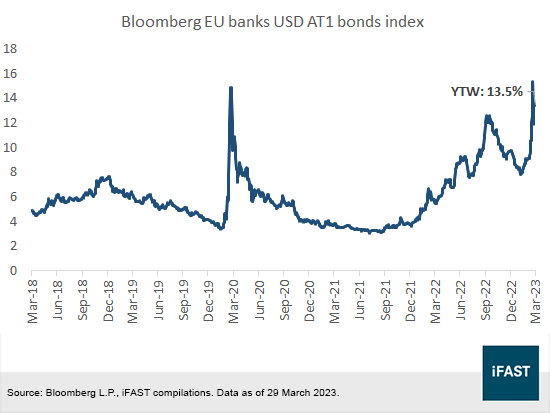
After the CS write-off event, AT1 bonds have sold off and yields for AT1 bonds have peaked close to Covid-19 levels. Currently, AT1 bonds have a Yield to Worst (“YTW”) of 13.5% (Chart 1). The previous time AT1s were trading at these levels was during the Covid-19 recession in 2020. Higher risk have been priced into AT1 bonds due to the current turmoil in the banking sector. The full write-off of CS AT1 bonds ahead of its equity shareholders also puts in question the capital structure hierarchy of AT1 bondholders. The uncertainty in how AT1 bondholders will be treated during a viability event have been priced into AT1 bond yields.
Taking a look at the various type of loss absorption in SGD AT1 bonds (Table 1), there are varying levels of “strictness” for the type of loss absorption an AT1 bond will receive. Swiss banks in particular have strict loss absorption clauses where AT1 bonds will be written down permanently as compared to French AT1 bonds from Societe Generale and BNP Paribas where there is a temporary write down clause. A temporary write down means that in an event of a write down in AT1 bonds, the principal amount of the AT1 bonds written down may be replenished by the bank at its discretion upon a recovery of the bank’s financial health. With that said, we think it is unlikely that principal amount will be replenished when a bank faces insolvency. Thus, it is best to assume that AT1 bonds will be fully written down during an insolvency event.
In light of the full write-down of CS AT1 bondholders ahead of its equity shareholders, regulators have issued statements to calm AT1 bondholders. Singapore’s MAS released a statement to say they will abide by the hierarchy of claims during a liquidation. This means that equity shareholders will absorb losses first before AT1 and Tier 2 bondholders. Similarly, European and UK banking regulators issued similar messages to AT1 bondholders. The Single Resolution Board, the European Banking Authority and the ECB Banking Supervision in a joint statement stated that creditors will only bear losses after equity holders have been wiped out while the Bank of England stated that the UK has a clear statutory order for bearing losses with AT1 bonds ranking ahead of equity shareholders.
All in all, when investing in AT1 bonds, investors should understand the risk involved. AT1 bonds are capital instruments that banks issue in order to have bondholders absorb losses during an insolvency event. Therefore, at any point in time, it is at the discretion of the bank and regulators to write-off these bonds during a viability event. While statements from regulators may have calmed AT1 bondholders, during a liquidation event, AT1 bondholders should still expect write-downs in AT1 bonds together with equity holders.
Looking ahead, we expect future AT1 issuances to be much more expensive going forward. Investor’s confidence in these bonds have been shaken, not only due to the write-down of the bonds but also how regulators ignored the hierarchy of claims. AT1 bonds may not differ much from equity as initially thought and this increased risk may be priced in future AT1 issuances.
Table 2: Various loss absorption features in SGD AT1 bonds
|
Bond name |
Type of loss absorption |
|
BACR 7.300% Perpetual Corp (SGD) |
Equity Conversion |
|
BACR 8.300% Perpetual Corp (SGD) |
Equity Conversion |
|
BNP 5.900% Perpetual Corp (SGD) |
Temporary Write Down |
|
CS 5.625% Perpetual Corp (SGD) |
Permanent Write Down |
|
DBSSP 3.980% Perpetual Corp (SGD) |
Permanent Write Down |
|
HSBC 5.000% Perpetual Corp (SGD) |
Equity Conversion |
|
OCBCSP 3.000% Perpetual Corp (SGD) |
Partial Permanent Write Down |
|
OCBCSP 3.900% Perpetual Corp (SGD) |
Partial Permanent Write Down |
|
OCBCSP 4.000% Perpetual Corp (SGD) |
Partial Permanent Write Down |
|
SOCGEN 6.125% Perpetual Corp (SGD) |
Temporary Write Down |
|
SOCGEN 8.250% Perpetual Corp (SGD) |
Temporary Write Down |
|
STANLN 5.375% Perpetual Corp (SGD) |
Equity Conversion |
|
UBS 4.850% Perpetual Corp (SGD) |
Permanent Write Down |
|
UBS 5.875% Perpetual Corp (SGD) |
Permanent Write Down |
|
UOBSP 2.250% Perpetual Corp (SGD) |
Permanent Write Down |
|
UOBSP 2.550% Perpetual Corp (SGD) |
Partial Permanent Write Down |
|
UOBSP 3.580% Perpetual Corp (SGD) |
Permanent Write Down |
|
UOBSP 4.250% Perpetual Corp (SGD) |
Partial Permanent Write Down |
|
UOBSP 5.250% Perpetual Corp (SGD) |
Permanent Write Down |
|
Source: Bloomberg L.P., iFAST compilations. |
|
Higher non-call risks for AT1 bonds
As AT1 bond yields have risen after the events of CS, majority of SGD AT1 bonds within our coverage have become more expensive to refinance. In the past, banks have regularly called back their AT1 bonds on its first call date and replaced it by issuing a new AT1 bond. Investors should not assume that every AT1 bond will be called back on its first call date. It is at the discretion of the bank to call back the bond as ultimately it is a perpetual bond in nature.
AT1 bond spreads have widen in recent times due to the events of CS and this made issuing of new AT1 bonds much more expensive than before. Therefore, banks may not be incentivised to redeem their AT1 bonds on their first call date and choose to have the bond reset instead. We are cautious on the extension risk for AT1 bonds with nearer call dates as refinancing these bonds may be costly for the bank and the bank may opt to have the bond reset instead. Last week, Deutsche Pfandbriefbank AG, a German real estate lender, opted to miss its call date and cited that market conditions and economic costs were the factors that led to the non-call. As it will take some time for market sentiment to cool from the recent turmoil in the banking sector, we expect to see more non-calls for AT1 bonds in the near future.
While spreads of AT1 bonds have widen, we still think it is not reflective of the risks AT1 bonds entails. As most AT1 bonds are rated a few notches from the bank’s issuer rating, most AT1 bonds are non-investment grade. The initial spreads of the AT1 bonds should reflect the high yield nature of the bond. Currently, high yield USD bonds are trading at a spread of 480 basis points (“bps”) above benchmark rates and we think AT1 bond spreads should be reflective of that. A high initial spread will properly compensate the risk when investing in AT1 bonds and reflect yields close to the cost of equity of banks.
For investors who want to take on risk in investing in AT1 bonds, we prefer AT1 bonds with high initial spreads above 500 bps. The BACR 8.300% Perpetual Corp (SGD) has a high initial spread of 564 bps. The bond also has a further call date in 2027 which will allow AT1 bond markets to stabilise and allow the bank to refinance it at a cheaper rate. At a coupon of 8.30%, we think it is reflective of the risk that AT1 bonds entail and investors will be compensated for investing in these risky bonds.
Lastly, we would like to end off on two key takeaways – 1) AT1 bonds are bank capital instruments that banks issue to absorb losses during an insolvency event and loss absorption should be expected whenever a bank is liquidated. 2) As AT1 bonds are perpetual in nature, it is at the bank’s sole discretion to call back the bonds and it should not be assumed that the bond will be called back on its first call date.
Table 3: Cost of issuing new AT1 bonds have risen
|
Name |
First Call date |
Bond Price |
Reset Rate |
Indicative Reset rate on first call date (%) [a] |
Cost of Issuing New NC5 Perps |
Cost of issuing new NC5 perps vs reset (%) [b-a] |
|
OCBCSP 4.000% Perpetual Corp (SGD) |
24 Aug 2023 |
99.4 |
5Y SGD SOR +1.81 |
5.02% |
5.93% |
0.9% |
|
HSBC 5.000% Perpetual Corp (SGD) |
24 Sep 2023 |
95.1 |
5Y SGD SOR +2.67 |
5.87% |
7.08% |
1.2% |
|
UBS 5.875% Perpetual Corp (SGD) |
28 Nov 2023 |
96.2 |
5Y SGD SOR +3.61 |
6.81% |
8.00% |
1.2% |
|
SOCGEN 6.125% Perpetual Corp (SGD) |
16 Apr 2024 |
90.1 |
5Y SGD SOR +4.21 |
7.41% |
9.11% |
1.7% |
|
CS 5.625% Perpetual Corp (SGD) |
6 Jun 2024 |
5.0 |
5Y SGD SOR +3.77 |
6.97% |
N.M. |
N.M. |
|
UBS 4.850% Perpetual Corp (SGD) |
4 Sep 2024 |
91.5 |
5Y SGD SOR +3.37 |
6.58% |
7.97% |
1.4% |
|
STANLN 5.375% Perpetual Corp (SGD) |
3 Oct 2024 |
92.8 |
5Y SGD SOR +3.68 |
6.89% |
8.22% |
1.3% |
|
DBSSP 3.980% Perpetual Corp (SGD) |
12 Sep 2025 |
97.3 |
7Y SGD SOR +1.65 |
4.84% |
5.72% |
0.9% |
|
UOBSP 2.250% Perpetual Corp (SGD) |
15 Jan 2026 |
92.9 |
5Y SGD SORA +1.81 |
4.72% |
5.24% |
0.5% |
|
UOBSP 3.580% Perpetual Corp (SGD) |
17 Jul 2026 |
95.7 |
7Y SGD SOR +1.8 |
4.98% |
5.28% |
0.3% |
|
OCBCSP 3.900% Perpetual Corp (SGD) |
8 Jun 2027 |
96.0 |
5Y SGD SORA +1.42 |
4.32% |
4.92% |
0.6% |
|
SOCGEN 8.250% Perpetual Corp (SGD) |
15 Jul 2027 |
92.3 |
5Y SGD SORA +5.6 |
8.51% |
9.61% |
1.1% |
|
BACR 8.300% Perpetual Corp (SGD) |
15 Sep 2027 |
93.5 |
5Y SGD SORA +5.64 |
8.55% |
9.65% |
1.1% |
|
UOBSP 4.250% Perpetual Corp (SGD) |
4 Oct 2027 |
96.4 |
5Y SGD SORA + 1.47% |
4.38% |
5.01% |
0.6% |
|
UOBSP 5.250% Perpetual Corp (SGD) |
19 Jan 2028 |
102.0 |
5Y SGD SORA + 2.39% |
5.30% |
4.86% |
-0.4% |
|
BNP 5.900% Perpetual Corp (SGD) |
28 Feb 2028 |
91.1 |
5Y SGD SORA + 2.67% |
5.58% |
6.68% |
1.1% |
|
BACR 7.300% Perpetual Corp (SGD) |
15 Jun 2028 |
89.7 |
5Y SGD SORA + 3.93% |
6.83% |
8.37% |
1.5% |
|
UOBSP 2.550% Perpetual Corp (SGD) |
22 Jun 2028 |
88.3 |
7Y SGD SORA + 1.55% |
4.42% |
5.03% |
0.6% |
|
OCBCSP 3.000% Perpetual Corp (SGD) |
30 Sep 2030 |
87.4 |
10Y SGD SOR + 2.19% |
5.36% |
5.36% |
0.0% |
|
Source: Bloomberg L.P., iFAST Compilations. |
||||||
Declaration: For specific disclosure, at the time of publication of this report, IFPL (via its connected and associated entities) holds a position in BACR 8.300% Perpetual Corp (SGD), HSBC 5.300% 14Mar2033 Corp (SGD), OCBCSP 3.900% Perpetual Corp (SGD), UBS 5.875% Perpetual Corp (SGD), UOBSP 2.550% Perpetual Corp (SGD), UOBSP 4.250% Perpetual Corp (SGD), HSBC 6.500% 20May2024 Corp (GBP), STANLN 4.300% 19Feb2027 Corp (USD), HSBC 4.375% 23Nov2026 Corp (USD) and the analyst who produced this report holds a NIL position in the abovementioned securities.
Our podcast series, Yield Hunters, is available on Spotify, iTunes Podcasts and Google Podcasts. We share our thoughts on new bond issues and hold discussions on the fixed income space. Listen to our latest episode below and follow us!